Pocket Life World: Avatar Town
- 4.7
- Rating
- 5.00M
- Installs
- Free
- Price

 Analysis by App-foxy
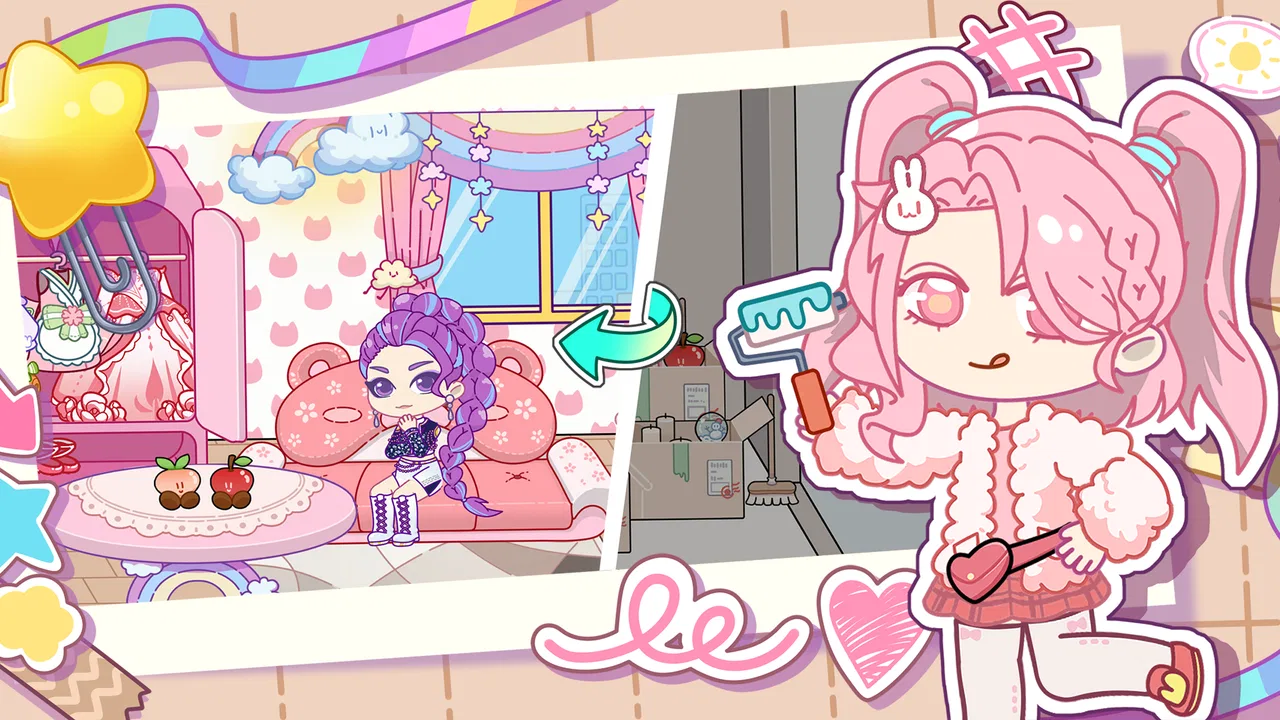
I spent time with Pocket Life World: Avatar Town as a relaxed educational game built around creating an anime-style avatar, dressing up cute characters, and arranging a personal life-themed world. The first impression is deliberately gentle: there is no intimidating opening lesson or complicated control scheme. Instead, the game invites me to make a character, experiment with appearance, and turn a small virtual space into something that feels like mine.
That simple approach is the main reason I can see it appealing to children and casual players. It also explains why the game works better as a creative routine than as a traditional challenge-based game. I am not playing to defeat an opponent or master a difficult level. I am playing to make small choices, check the result, and continue shaping the world. That can be satisfying, although anyone expecting deep strategy, demanding puzzles, or a strong competitive loop may find the experience too light.
Created by Cub Leopard, this free game sits in the educational category and is suitable for Everyone. It has reached over a million installs and holds a 4.7 average from around fourteen thousand ratings, which suggests that the accessible avatar-and-doll format has found a substantial audience. The current version is 1.210, and it runs on Android 6.0 or later. Optional purchases range from $0.99 to $49.99 per item, so I would pay attention to how a child uses the game, even though the basic download costs nothing.
You May Also Like

 Blood Strike: 2.5 Anniversary
Blood Strike’s Loadouts Turn Every Drop Into a Tactical Gamble
A close look at Blood Strike’s custom loadouts: how fast access to signature weapons reshapes its battle royale rhythm, rewards preparation, and narrows the gap between fights.

 Pandora - Music & Podcasts
Pandora’s Music Is Easy to Start, but Harder to Recover
Pandora’s strength is its low-effort path from a seed to a station. Its weak spot is how much confidence it asks you to place in connection, setup, and quiet recovery.

 8 Ball Pool
 Is Built on Rivalries, Rematches, and Routine
A close look at the rivalries, rematches, shared routines, and unanswered safety questions that turn a quick pool match into a persistent mobile community.

 Samsung Music
’s Quiet Strength Is Playing What You Already Own
Its reach comes less from spectacle than from dependable access to a personal library. That simplicity is both the app’s strongest retention engine and its ceiling.

 AccuWeather: Weather Radar
AccuWeather Review: A Quick, Clear Forecast for Everyday Decisions
For everyday plans, the best forecast is the one you can understand quickly. AccuWeather makes rain timing, radar, and local conditions easy to act on, with a few trade-offs.

 Hill Climb Racing
Why Hill Climb Racing Still Turns Crashes Into One More Run
A tiny car, a bumpy hill and one more upgrade: Hill Climb Racing keeps resurfacing because its simple chaos makes every near-miss feel personal.
More From Our News Desk



How the first session turns creativity into a goal
The strongest early goal is personal rather than competitive: create a character that feels right to you. Choosing an avatar, trying different outfits, and arranging a setting gives the opening session a clear direction without forcing the player to understand a large rule system. I found that useful because the game communicates its purpose through action. You do not need a long explanation to understand why you are changing a hairstyle or moving an object; the reward is seeing your idea take shape.
This kind of opening is especially effective for younger players who may not be ready for complex menus. It also suits a quick break after school or a few quiet minutes before bed. A child can open the game with a small intention, such as making a new outfit or improving a room, and finish with a visible result. That sense of completion matters more here than a score.
The early customization choices also create a natural reason to return. Once I had made one version of a character, I immediately started thinking about alternatives: a different look, a new arrangement, or a setting with another mood. The game’s central loop is therefore easy to understand: choose, place, adjust, and look at the finished scene. It is a modest loop, but it is clear and friendly.
One useful way to approach the opening is to avoid trying to decorate everything at once. I get more enjoyment by deciding on a theme first, then choosing the avatar and objects around it. For example, I might begin with a calm home scene and select clothing that matches it, rather than filling the space randomly. This turns a broad creative sandbox into a small project and gives the session a stronger sense of purpose.
That approach also reveals the game’s educational value. It is not teaching through conventional quizzes or formal lessons. Instead, it encourages visual organization, decision-making, and imaginative storytelling. A child can create a scene and explain who lives there, what they are doing, or why the room looks a certain way. Parents looking for a game that quietly supports creative expression may appreciate that format more than a purely passive dress-up toy.
Progress is visible, but it is not built around mastery
The clearest progress signals come from the world itself. A character looks different after customization, and a space feels more personal after decoration. Those changes are immediate, so the player does not have to wait for a distant reward to see the effect of an action. I consider that one of the game’s best design decisions because it keeps the feedback understandable for first-time players.
At the same time, the progress is mainly expressive. I would not describe it as a deep advancement system where skills improve through increasingly demanding tasks. The satisfaction comes from collecting ideas and refining a scene rather than from proving that I can overcome a difficult obstacle. That distinction is important when deciding whether this game will hold your attention.
For a child, a parent, or a sibling playing together, the finished scene can become the progress record. Instead of asking, “What level are you on?” the more useful question is, “What did you create today?” This makes the game easy to share informally. A player can show an avatar, explain a room, or compare two designs without needing a leaderboard or complicated achievement screen.
I also found that taking a screenshot or simply pausing to inspect the scene can make the creative process feel more complete, although the game itself does not need to turn every creation into a formal achievement. The important point is to treat each design as a small finished piece. If you rush through choices just to unlock the next item, the experience can feel thin; if you use the available customization thoughtfully, the same session becomes more rewarding.
The trade-off is that players who need explicit milestones may wonder what they are working toward after the initial novelty fades. The avatar and world provide visual feedback, but that is different from a structured campaign. In my experience, the game is most engaging when I bring my own goals into it, such as designing a themed room, creating several contrasting outfits, or building a little story around the characters.
What the difficulty curve feels like in practice
The difficulty curve is very gentle. There is no steep learning wall at the beginning, and the basic idea can be understood by experimenting. That makes the game approachable for the Everyone age rating and removes the frustration that often appears when a child has to memorize rules before enjoying the creative part.
Gentle difficulty is not automatically a weakness. Here, it supports the intended mood. A player can focus on appearance and arrangement instead of worrying about failure. I can change my mind, try another combination, and treat mistakes as part of the design process. For younger users, that freedom may be more valuable than a demanding progression ladder.
However, the same softness limits long-term challenge. If you usually play games for increasingly complex puzzles, precise timing, resource management, or difficult goals, this will probably feel underpowered. The game does not seem designed to test reflexes or strategic planning. Its challenge is self-directed: deciding what looks good, what story a scene should tell, and how to make a personal space feel coherent.
That makes it a better alternative to a competitive mobile game when you want something calm, but a weaker alternative to a dedicated puzzle or learning app when you want measurable skill development. I would not install it expecting lessons that become progressively harder. I would install it for creative play with a light educational flavor.
A practical tip is to increase the difficulty for yourself through design constraints. I might choose one color family, create an outfit for a particular occasion, or decorate a space around a simple story. These limits are not imposed by the game, so they will not suit every player, but they give older children and adults a reason to think more carefully about each choice. The result feels less like tapping through options and more like completing a small creative brief.
Where the pacing succeeds and where it loses momentum
The pacing works best in short, purposeful sessions. I can open the game, make one meaningful change, and leave without feeling that I abandoned a long mission. That is convenient for families and casual players. It also means the game does not punish me for taking a break, because the appeal is based on returning to a personal world rather than keeping up with a fast-moving competition.
The downside is that the same relaxed rhythm can become repetitive. Once the initial excitement of making an avatar has passed, the player needs a reason to keep experimenting. Self-directed creativity can provide that reason, but not everyone enjoys inventing their own objectives. Some players want a clear chain of tasks, a story that pushes them forward, or a stronger sense that each session unlocks something important.
I would describe the retention pressure as mild rather than aggressive in the way the game presents itself. The main pull comes from curiosity and personalization: I want to see another look, refine a scene, or continue a small imaginary story. That is healthier for casual play than a design that makes me feel forced to return constantly. Still, optional in-app purchases mean families should treat the game as a free entry point with paid items available, not as a completely purchase-free experience. The per-item range reaches from $0.99 to $49.99, so device-level purchase safeguards are sensible.
This is also where the game differs from many conventional alternatives. A dress-up title may focus almost entirely on outfits, while a life-simulation game may bury simple creativity under schedules, currencies, or management tasks. Pocket Life World: Avatar Town feels more immediate than those formats because the player can concentrate on the character and surroundings. The trade-off is that it may offer less depth and fewer long-term systems than a larger simulation.
For an everyday scenario, imagine a child waiting while a parent finishes an appointment. The child can create an outfit, arrange a small scene, and explain the result afterward. There is no need to remember a complicated quest or reach a checkpoint before closing the app. In that situation, the gentle pacing is a real strength. On a long journey where the player wants hours of escalating content, the lack of stronger goals may become more noticeable.
Who will enjoy it, and who should choose something else
I think this game is a good fit for children who enjoy dolls, outfits, characters, and room decoration but may not be ready for demanding controls. It also suits parents looking for a creative activity that can encourage storytelling and visual choices. Because the controls and purpose are easy to grasp, it can work as a shared activity: one person chooses the character concept, another suggests the setting, and both discuss what the finished scene represents.
It may also appeal to anime-style avatar fans who want a low-pressure space to experiment. The focus on personal presentation gives the player room to explore different identities and moods without tying every choice to a win-or-lose result. That can make the game feel more welcoming than competitive social experiences.
I would skip it if your priority is serious academic instruction. The educational label should not be mistaken for a structured replacement for a reading, mathematics, language, or science app. Its learning value is indirect and creative. I would also look elsewhere if you want a robust story campaign, a demanding challenge curve, or a multiplayer contest. The game’s appeal depends on enjoying customization for its own sake.
Parents should also decide whether the available purchase options fit their household rules before handing over the device. Since the game is free to start but includes items priced up to $49.99, I would use the platform’s purchase controls and explain clearly which content is optional. That conversation is more useful than assuming the free download means there will never be a payment prompt.
Device fit, access, and the practical decision
The Android requirement is relatively broad because the game supports Android 6.0 and later. That makes it a practical option for people using an older compatible phone or tablet rather than a recent flagship device. I would still keep the app updated to version 1.210 when possible, since using the current version is generally the simplest way to avoid problems caused by an outdated installation.
The game is free, which lowers the barrier to trying it. I like that a family can first decide whether the creative loop suits the child before spending anything. The important distinction is between access and completion: the free version lets you explore the basic idea, while optional items can become tempting for players who want more ways to personalize their world.
Because the experience is visual and choice-driven, a tablet may be more comfortable than a small phone for decorating and inspecting scenes. A phone remains convenient for quick sessions, but the larger display gives younger players more room to see what they are changing. I consider that a useful setup choice, especially if the game becomes a shared creative activity rather than something played alone.
Its popularity and strong average rating make it easy to understand why people try it, but those figures should not replace a personal fit test. A high rating does not mean every player will enjoy a calm, open-ended loop. The real question is whether the person using it likes making characters and spaces without needing constant objectives.
My progression verdict after playing
Pocket Life World: Avatar Town succeeds when it treats progress as expression. The early goals are clear, the visual results arrive quickly, and the low difficulty makes experimentation comfortable. I can recommend it as a friendly creative game for children and casual players who want anime-inspired avatars, dress-up choices, and a personal world to arrange.
Its limitations are equally clear. The challenge curve is soft, the progression depends heavily on self-made goals, and the relaxed pacing may not sustain players who need a strong story or increasingly difficult tasks. The optional purchases also deserve attention from parents, particularly because the available price range is wide.
My final view is that this is best used as a short-session creativity game rather than a complete educational curriculum or a deep life simulator. If you want a calm place to design a character, build a scene, and invent small stories, I think it is worth trying for free. If you want measurable lessons, serious strategy, or a demanding sequence of unlocks, another category of game will serve you better. For the right player, though, the modest goals are not a problem; they are what keeps the experience approachable.
FAQs for Pocket Life World: Avatar Town
01What is Pocket Life World: Avatar Town?
Pocket Life World: Avatar Town is a dynamic simulation game where players can create and customize their own avatar, explore a vibrant town, and engage in various activities. The game offers a wide array of interactive environments and mini-games, making it a perfect choice for those who enjoy creativity and exploration.
02Is Pocket Life World: Avatar Town free to play?
Yes, Pocket Life World: Avatar Town is free to download and play on both Android and iOS platforms. However, it does offer in-app purchases for items and customization options. These purchases are completely optional and not necessary to enjoy the core gameplay experience.
03What age group is suitable for Pocket Life World: Avatar Town?
Pocket Life World: Avatar Town is designed for players of all ages. Its user-friendly interface and engaging content make it accessible to children and adults alike. However, parental guidance is recommended for younger players due to optional in-app purchases and online interactions.
04Does Pocket Life World: Avatar Town require an internet connection?
The game can be played offline, allowing users to enjoy most features without an internet connection. However, certain aspects like accessing new content updates, participating in online events, and making in-app purchases will require a stable internet connection.
05How customizable are the avatars in Pocket Life World: Avatar Town?
Players have extensive customization options for their avatars in Pocket Life World: Avatar Town. You can personalize your avatar’s appearance, clothing, and accessories. The game frequently updates with new items, allowing for endless creativity and personalization to suit individual tastes.
Pros
- Wide variety of customization options.
- Engaging and interactive storylines.
- User-friendly interface for all ages.
- Regular updates with new content.
- Offline mode available for play.
Cons
- In-app purchases can be expensive.
- Occasional bugs affect gameplay.
- Some features require internet access.
- Advertisements may interrupt gameplay.
- Limited character slots without purchase.

Pocket Life World: Avatar Town
Gallery